August 8, 2026
Understanding B2C Business to Consumer Dynamics

Brand consistency matters in branding. This comprehensive guide covers brand identity, audience trust, strategic frameworks, and common pitfalls to avoid.

Most brands lose up to 23 percent of potential revenue when their messaging or visuals are inconsistent, according to industry research. In a world where consumers encounter hundreds of brands daily, standing out takes more than a flashy logo or catchy slogan. True brand consistency builds trust, sparks recognition, and provides a solid foundation for lasting customer loyalty. Understanding how to create and maintain this uniformity can completely change the way your audience experiences your business.
Brand consistency is the strategic practice of presenting your business’s core identity, messaging, and visual elements uniformly across all communication channels. Think of it like your brand’s signature—instantly recognizable, reliable, and reflecting a coherent personality no matter where customers encounter you.
At its core, brand consistency means creating a unified experience that reinforces your company’s values, mission, and unique positioning. This goes beyond just using the same logo or color palette. It encompasses the tone of voice in your marketing materials, the way customer service representatives interact with clients, the design of your website, and even the style of your social media posts. When executed effectively, brand consistency transforms your business from a random collection of touchpoints into a cohesive, memorable narrative.

The fundamental elements of brand consistency include:
Understanding how to maintain brand consistency requires a holistic view. Learn more about brand identity essentials to dive deeper into creating a comprehensive brand strategy. The goal isn’t just repetition—it’s about creating a trustworthy, professional image that resonates with your target audience and differentiates you in a crowded marketplace.
Building a consistent brand requires strategic focus on three primary interconnected elements that work together to create a unified and memorable brand experience.
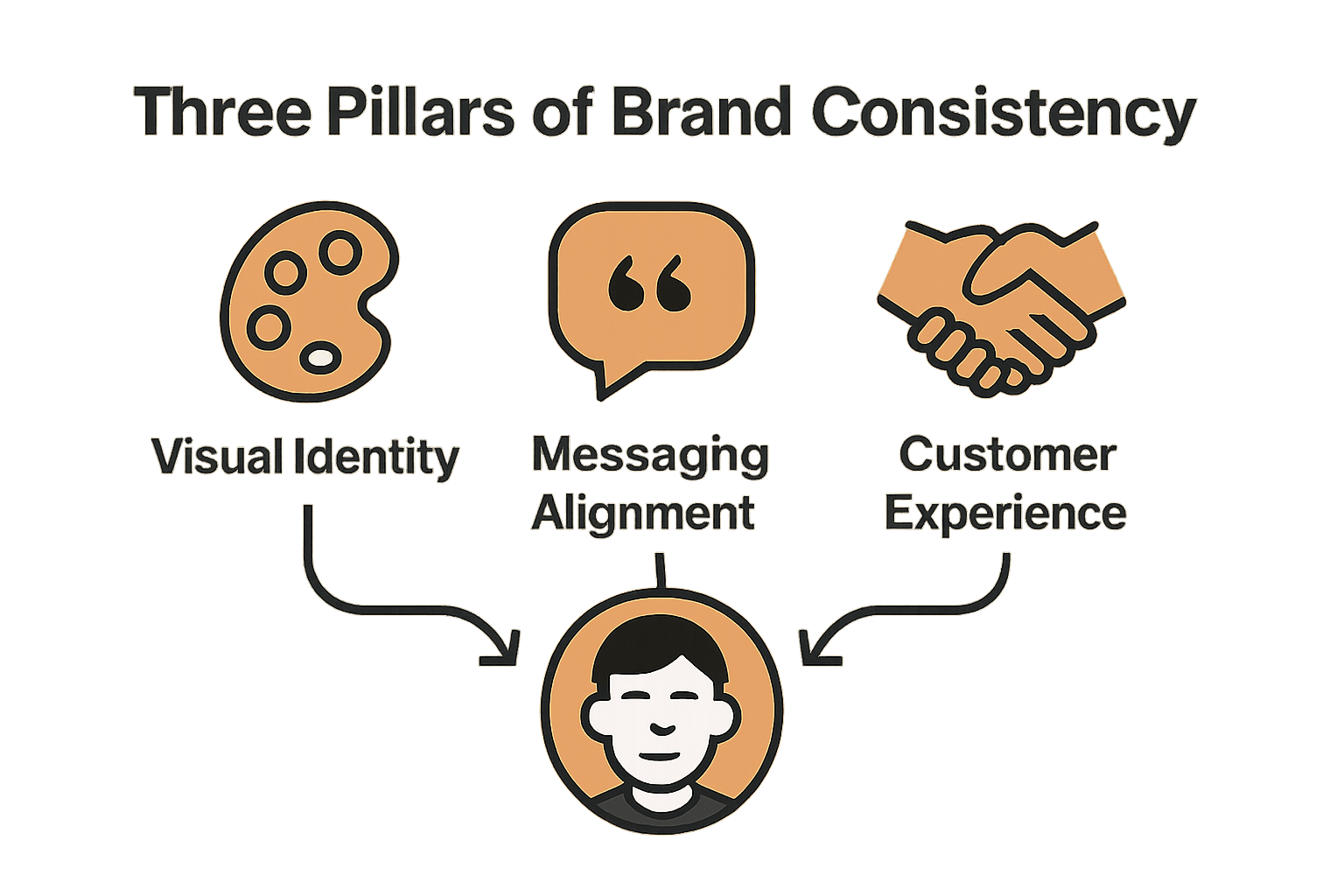 Visual Identity, Messaging Alignment, and Customer Experience form the foundational framework that transforms scattered interactions into a cohesive brand narrative.
Visual identity serves as the most immediate and recognizable aspect of brand consistency. This encompasses more than just your logo—it includes color palettes, typography, imagery style, and design standards that create a visual language unique to your brand. Forbes research highlights that uniform visual elements across all platforms are crucial, ensuring that whether a customer sees your social media post, website, or marketing brochure, they instantly recognize your brand’s visual signature.
The second critical element is messaging and tone consistency. This goes beyond surface-level communication and digs into the core of how your brand communicates its values, personality, and unique positioning. Adobe’s research emphasizes that consistent messaging should harmoniously align across all touchpoints, from website copy to customer service interactions. Your brand’s voice should feel authentic and coherent, whether it’s a tweet, an email, or a product description.
Lastly, customer experience acts as the practical manifestation of your brand consistency. This involves maintaining a uniform quality of interaction, service standard, and emotional connection across every customer touchpoint. Explore our guide on consistency in branding to understand how these elements interplay to create a powerful, trustworthy brand presence that resonates with your target audience and differentiates you in a competitive marketplace.
Building trust and recognition through brand consistency is more than a marketing strategy—it’s the foundation of meaningful connections with your audience. When customers encounter a brand that presents itself uniformly across all platforms, they experience a sense of reliability and predictability that transforms casual interactions into lasting relationships.
Grammarly’s research reveals a powerful insight: consistent branding dramatically increases the likelihood of customer loyalty by fostering familiarity and trust. Think of your brand like a trusted friend—someone who shows up the same way every time, speaks with the same voice, and delivers on promises. This consistency projects authority and confidence, enhancing your brand’s perceived expertise and value in the marketplace. When customers know exactly what to expect from your brand, they feel secure in their choice and more likely to recommend you to others.
The psychological impact of consistent branding runs deep. Trust Formation happens through repeated, reliable experiences that align with customer expectations. According to DCC research, this consistency creates a foundation for long-lasting customer relationships by making people feel emotionally secure in their interactions with your brand. It’s not just about looking professional—it’s about creating a predictable, dependable presence that speaks directly to your audience’s need for certainty in an unpredictable world.
Learn how to improve brand recognition and transform these trust-building principles into actionable strategies. By understanding the deep psychological mechanisms behind brand consistency, you can craft experiences that don’t just attract customers, but genuinely connect with them on a meaningful level. The result? A brand that doesn’t just sell products or services, but builds genuine, lasting relationships.
A cohesive brand strategy transforms your business from a collection of disconnected efforts into a powerful, unified force that resonates deeply with your target audience. By creating a deliberate, intentional approach to how your brand communicates and presents itself, you unlock a series of strategic advantages that can dramatically accelerate your business growth and market positioning.
According to research from Marq, a comprehensive brand strategy encompasses far more than visual aesthetics—it includes a clear mission statement, well-established core values, consistent content strategy, and a distinctive brand voice. Market Differentiation emerges as one of the most significant benefits. In a crowded marketplace where consumers are bombarded with countless messages, a cohesive brand strategy cuts through the noise, helping your business stand out and be remembered. It’s not just about looking good—it’s about creating a memorable, distinctive presence that potential customers can instantly recognize and connect with.
The strategic benefits extend beyond mere visibility. A well-crafted brand strategy creates Operational Efficiency by providing a clear framework for decision-making across your entire organization. When every team member understands the brand’s core values, mission, and communication style, they can make more aligned choices that reinforce the brand’s overall narrative. This internal coherence translates directly into a more professional, trustworthy external perception, reducing friction in customer interactions and creating a smoother, more intuitive brand experience.
Discover why brand strategy matters and learn how a thoughtful, integrated approach can transform your business from a generic option to a compelling, must-choose brand. By investing in a cohesive strategy, you’re not just creating marketing materials—you’re building a comprehensive system that attracts the right customers, builds lasting trust, and sets the foundation for sustainable, meaningful growth.
Brand inconsistency is like sending mixed signals in a critical relationship—it confuses your audience, erodes trust, and ultimately undermines the entire foundation of your business’s reputation. What might seem like minor variations in messaging, visual design, or communication style can quickly snowball into significant credibility challenges that push potential customers away.
Research from the University of Nevada reveals a stark warning: inconsistent branding produces Mixed Messaging that directly damages customer trust. Imagine a brand that speaks professionally on its website but uses casual, unpredictable language on social media. This dissonance creates cognitive friction, making customers question the brand’s authenticity and reliability. Indeed’s research confirms this, highlighting that inconsistent branding portrays an organization as untrustworthy and unprofessional, making it exponentially harder to distinguish yourself from competitors.
The most common pitfalls of brand inconsistency emerge in several critical areas. These include:
These inconsistencies don’t just look unprofessional—they actively undermine your brand’s perceived competence and reliability. When customers cannot predict your brand’s behavior, they become hesitant to invest their time, money, or trust. Learn more about building a consistent brand strategy to transform these potential pitfalls into opportunities for creating a robust, trustworthy brand presence that resonates confidently with your target audience.
The article highlights the risks of scattered messaging and shifting brand voices that undermine audience trust and recognition. You may find yourself struggling with mixed signals across visuals, tone, and customer experience making it harder to build meaningful connections or stand out in a crowded market. The challenge is to bring clarity and cohesion to your brand’s core elements—visual identity, messaging alignment, and customer experience—so they all work together seamlessly. This is where strategy meets emotional resonance.
Reasonate Studio’s proprietary Aligned Impact Model™ tackles these exact pain points by helping you define your brand foundations like values and messaging before guiding you through visibility and consistent execution. With options tailored to your business needs—DIY, done-with-you, or done-for-you—this approach ensures your marketing is not only strategic but sustainable and emotionally intelligent. Don’t let inconsistent branding hold back your growth or dilute your impact.
Ready to transform fragmented efforts into a unified brand that resonates deeply and builds lasting trust?
Explore how you can achieve true brand consistency today with Reasonate Studio. Learn more about why brand strategy matters and how to develop a consistent brand strategy that positions your business for long-term success.
Brand consistency is the strategic practice of presenting a business’s core identity, messaging, and visual elements uniformly across all communication channels to create a recognizable and reliable presence for customers.
Brand consistency builds trust and recognition among audiences, making interactions feel reliable and predictable. It fosters customer loyalty and sets a brand apart in a crowded marketplace.
The core elements include visual identity (logo, color schemes, typography), messaging (tone of voice, communication style), core values, and customer experience, which collectively reinforce a brand’s unified narrative.
Inconsistency can confuse audiences, erode trust, and damage a brand’s reputation. Common pitfalls include mixed messaging, dramatically shifting tones across platforms, and varied customer experiences, which can undermine perceived reliability and professionalism.