August 8, 2026
Understanding B2C Business to Consumer Dynamics

Learn how to develop a marketing strategy using simple, step-by-step methods, ensuring clarity, alignment, and measurable results for small businesses.

Most new businesses miss out on growth because they skip the hard questions at the start. The companies that thrive build a strong foundation and set clear business goals from day one. Research shows that brands with defined strategies are up to 60 percent more likely to see successful long-term results. With the right steps, you can move from random marketing efforts to a plan that truly reaches your customers and drives real progress.
Defining your brand foundations and business goals transforms your marketing from random tactics to a strategic roadmap. This crucial first step helps you understand who you are as a business and what you want to achieve.
Start by articulating your core values and unique positioning. Think deeply about what makes your business different from competitors. Understanding your business brand requires honest self reflection about your mission, target audience, and the specific problems you solve. Drawing inspiration from brand strategy experts like David Aaker and Kevin Lane Keller, focus on building brand equity through clear awareness and meaningful associations.
To craft powerful business goals, use the SMART framework precision defining objectives that are Specific, Measurable, Achievable, Relevant, and Time bound. For example, instead of saying “grow my business,” specify “increase service revenue by 25% in the next six months by targeting small professional service firms.” These concrete goals will guide every marketing decision you make and help you track real progress.
Warning: Avoid the common mistake of creating generic goals that sound good but lack actionable substance. Check out strategies to prevent branding mistakes that could derail your marketing efforts.
With your brand foundations and goals established, you are now ready to develop a targeted marketing strategy that resonates with your ideal customers and drives meaningful business growth.
Identifying and segmenting your target audiences is the critical foundation that transforms generic marketing into precise, resonant communication. This step helps you understand exactly who will find the most value in your products or services.
Begin by creating detailed customer personas that go beyond basic demographics. Learn how to create a marketing strategy that connects with your ideal clients by diving deep into their motivations, pain points, and aspirations. Utilize microsegmentation techniques to break down your broader market into highly specific groups. For instance, instead of targeting all small business owners, you might focus on female entrepreneurs in professional services aged 35 to 45 who are seeking scalable growth strategies.
To effectively segment your audience, consider multiple dimensions including psychographics, behavior patterns, geographic location, and purchasing power. Create 3 to 5 distinct personas that represent your most promising customer groups. Each persona should include key details like professional challenges, communication preferences, income range, and specific goals that your business can address.

Warning: Avoid the trap of creating too many personas or making them so broad that they lose meaningful distinction. Precision matters more than volume when segmenting your target market.
With your target audiences clearly defined, you are now prepared to develop messaging and marketing strategies that speak directly to their unique needs and aspirations.
Crafting clear messaging and positioning transforms your marketing from noise to meaningful communication that resonates deeply with your target audience. This critical step defines how potential customers perceive and understand the unique value your business offers.
Understanding the role of messaging strategy requires developing a compelling narrative that articulates your unique value proposition. Drawing from marketing research by Victoria and William Crittenden, focus on creating a positioning statement that clearly answers three key questions: Who are you? What do you do? Why should customers care? Your messaging should distill complex business offerings into simple, powerful statements that immediately communicate your distinct advantage.
Start by developing a core messaging framework that includes a primary positioning statement, key differentiators, and supporting proof points. For each target persona, adapt your messaging to highlight the specific benefits most relevant to their needs. This might mean creating slightly different messaging variations that speak directly to each segment while maintaining a consistent overall brand voice.
Warning: Avoid generic corporate speak or overused marketing language. Your messaging should feel authentic, specific, and genuinely reflective of your business personality.
With a clear messaging strategy in place, you are now prepared to develop targeted marketing communications that will effectively connect with and persuade your ideal customers.
Selecting the right marketing channels is crucial for transforming your strategic vision into tangible business growth. This step determines how you will reach and engage your target audiences most efficiently and effectively.
Review effective marketing strategy examples to understand how successful businesses optimize their channel selection. Drawing from recent research on micro targeting practices, prioritize channels where your specific target personas are most active and responsive. Begin by mapping out a comprehensive channel strategy that balances digital and traditional platforms based on your audience research and business goals. Consider channels like LinkedIn for professional services, Instagram for visually driven businesses, targeted email marketing, industry specific podcasts, and strategic networking events.
Apply a data driven approach to channel selection by analyzing potential return on investment, audience engagement rates, and alignment with your messaging strategy. Allocate your marketing budget strategically across channels that offer the best combination of reach, cost effectiveness, and potential conversion. This might mean investing 40% in digital advertising, 30% in content marketing, 20% in networking events, and 10% in experimental channels that could yield unexpected opportunities.
Warning: Avoid spreading your resources too thin across too many channels. Focus is key strategic marketing discipline.
With your marketing channels carefully selected, you are now prepared to develop targeted content and campaigns that will effectively reach and convert your ideal customers.
Implementing your marketing strategy is where theoretical planning transforms into real world results. This final step ensures your carefully crafted approach delivers tangible business growth through continuous evaluation and strategic adjustment.
Learn how to set marketing goals that drive business growth by establishing clear key performance indicators for each marketing channel and campaign. Drawing from advanced clustering research on customer preferences, develop a robust measurement framework that tracks not just surface level metrics like clicks and impressions, but deeper indicators of engagement and customer value. Set up tracking systems that monitor conversion rates, customer acquisition costs, lifetime value, and specific behavioral metrics unique to your business model.
Create a quarterly review process where you systematically analyze your marketing performance data. Look for patterns in customer response, identify which channels and messaging resonate most strongly, and be prepared to reallocate resources quickly. This might mean shifting budget from underperforming channels to those generating higher quality leads, or refining your messaging based on customer feedback and engagement trends.
Warning: Do not become paralyzed by data. Use metrics as a guide, not a rigid constraint. Be willing to experiment and pivot when the data suggests a new approach.
With a dynamic implementation and measurement strategy in place, you have built a marketing system that can adapt and grow alongside your business.
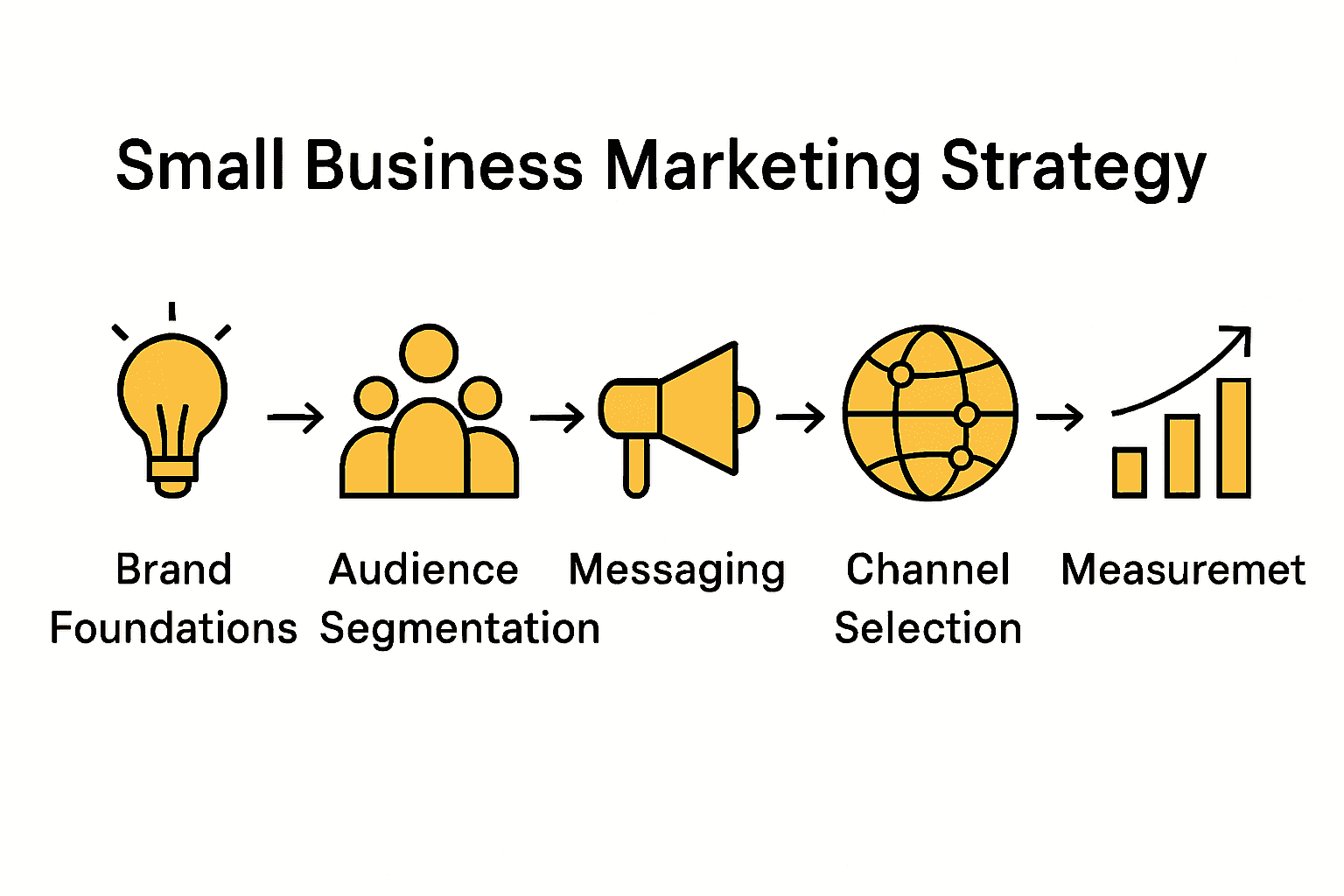
Struggling to turn your small business ideas into a clear, actionable marketing strategy? This article breaks down essential steps like defining your brand foundations, segmenting target audiences, and choosing the right channels to avoid wasted effort and unclear goals. Many small business owners face challenges with scattered tactics and messaging that misses the mark. If you want to stop spinning your wheels and start growing with confidence it is time to align your marketing with proven systems.
At Reasonate Studio, we understand these challenges deeply. Our proprietary Aligned Impact Model™ guides entrepreneurs step-by-step through uncovering your unique brand identity and connecting it with your ideal customers. This creates a sustainable marketing strategy that balances clarity, creativity, and measurable growth. Whether you prefer to do-it-yourself or want expert support our flexible approach meets you where you are. Visit Reasonate Studio today, learn how to craft a marketing strategy that scales your business with purpose, and get ready for real results. Discover how to set marketing goals that drive business growth and avoid common branding mistakes with strategic clarity from the start.
Defining your brand foundations involves clarifying your core values, unique positioning, and what sets you apart from competitors. Start by reflecting on your business mission and the problems you solve, which will guide your overall marketing direction.
SMART goals are specific, measurable, achievable, relevant, and time-bound objectives that help clarify your business ambitions. For example, instead of saying “increase sales,” aim to “boost service revenue by 20% in the next quarter by targeting tech startups.”
To create customer personas, gather detailed information about your target audience’s demographics, motivations, challenges, and purchasing behavior. Focus on building 3 to 5 distinct personas that represent your ideal customers, which will help tailor your marketing messages accordingly.
Your messaging should clearly communicate your unique value proposition and the specific benefits you provide to each customer persona. Develop a cohesive core message that can be adapted for different segments, ensuring it remains authentic and reflective of your brand’s personality.
Prioritize marketing channels where your target audience is most active, such as social media, email marketing, or networking events. Allocate your budget in a way that focuses on the top-performing channels, for example, invest 50% in digital strategies and 30% in content marketing to effectively reach your audience.
Measure your marketing strategy’s success by setting key performance indicators (KPIs) for each channel, such as conversion rates and customer acquisition costs. Review these metrics regularly—at least quarterly—to identify trends and adjust your tactics for improved results.